


Age Spots
Safe, Professional Age Spot Removal Using Advanced Electrolysis
Age spots are one of the most common reasons people visit our clinic. Although they are harmless, many people feel they make their skin look older than they feel, particularly when they appear on the face, hands, chest or shoulders.
Many clients tell us they assumed age spots were simply a part of getting older and that nothing could be done about them. The good news is that many age spots can be treated successfully using Advanced Electrolysis.
At Jems Health & Beauty in Whitefield, Manchester, every treatment begins with a thorough consultation. Before considering cosmetic removal, we’ll carefully assess the pigmentation to make sure it is suitable for treatment and discuss the results you can realistically expect.
Our priority is always your safety. If we’re not confident that a lesion is suitable for cosmetic treatment, we’ll tell you honestly and advise you on the most appropriate next step.

What Are Age Spots?
Age spots are flat areas of increased pigmentation that develop after years of exposure to ultraviolet (UV) light.
They are also commonly known as:
-
Sun Spots
-
Liver Spots
-
Solar Lentigines
Despite the name, they are not caused simply by getting older.
They develop because your skin has been exposed to sunlight over many years. As time passes, pigment-producing cells (melanocytes) can become overactive in certain areas, creating patches of darker pigmentation.

Why Do Age Spots Develop?
Age spots are caused by cumulative sun exposure.
Every time your skin is exposed to UV light, your body produces melanin to protect itself.
Over many years this repeated stimulation can cause pigment to collect in certain areas, resulting in permanent darker patches.
They are most commonly found on areas regularly exposed to the sun, including:
-
Face
-
Hands
-
Décolletage
-
Shoulders
-
Forearms
Are Age Spots Dangerous?
Most age spots are completely harmless.
However, not every brown mark is an age spot.
Some pigmented lesions require medical assessment before cosmetic treatment should ever be considered.
This is why every consultation at Jems begins with a careful assessment of the lesion before discussing treatment.
Is It Definitely an Age Spot?
One of the most important parts of your consultation is making sure we are treating the correct condition.
Not every brown mark is an age spot.
Sometimes pigmentation may be:
-
Melasma
-
Post-inflammatory pigmentation
-
Another pigmented lesion requiring medical assessment
We’ll examine:
-
The colour
-
The size
-
The borders
-
The texture
-
Whether it is flat or raised
-
How long it has been present
-
Whether it has changed over time
If we are ever unsure, we will not proceed with cosmetic treatment. Your safety will always come first.
Our Approach to Pigmented Lesions
At Jems Health & Beauty we believe professional assessment is just as important as the treatment itself.
If a lesion has an unusual appearance, has recently changed, is unusually large or raises any concerns during your consultation, we may recommend our Map My Mole service before considering cosmetic treatment.
Map My Mole provides access to expert dermatology review, helping ensure suspicious lesions are assessed appropriately before any cosmetic procedure is carried out.
Sometimes what appears to be an age spot may actually be a seborrhoeic keratosis or another benign skin lesion that requires a different treatment approach.
We’ll always explain exactly what we believe the lesion is and recommend the safest option for you.


Can All Age Spots Be Treated?
No. Although many age spots respond very well to Advanced Electrolysis, not all pigmentation is suitable.
For example:
-
Melasma cannot be treated using Advanced Electrolysis.
-
Very large areas of pigmentation may not be appropriate.
-
Some lesions require medical assessment before treatment.
We’ll always explain honestly whether your pigmentation is suitable.

How Does Advanced Electrolysis Remove Age Spots?
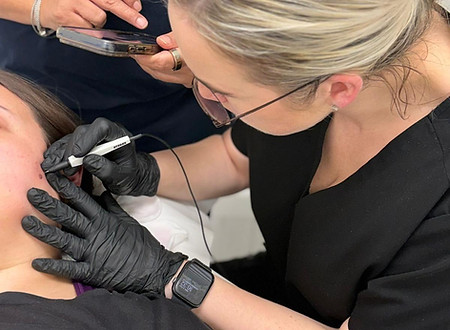
Advanced Electrolysis uses a very fine sterile probe to deliver a carefully controlled electrical current to the pigmented tissue.
The treatment encourages the pigmented cells to break down and be naturally removed as the skin heals.
The exact technique depends on the size, depth and location of the pigmentation.

What Happens During My Consultation?
We’ll carefully assess your pigmentation and ask questions including:
-
When did you first notice it?
-
Has it changed?
-
Has it become darker or larger?
-
Have you previously had it checked?
-
What are your treatment goals?
We’ll then explain:
-
Whether it is suitable for treatment.
-
What results you can realistically expect.
-
Healing time.
-
Aftercare.
-
Any possible risks.
Does Age Spot Removal Hurt?
Compared with verruca treatment, most clients describe age spot removal as a walk in the park.
You’ll usually feel a warm sensation or brief stinging feeling during treatment, but it is generally very well tolerated.
The amount you feel depends on:
-
The size of the lesion.
-
The area being treated.
-
Your individual pain threshold.
It’s also worth remembering that pain sensitivity isn’t always the same. Hormonal changes, including different stages of the menstrual cycle, can temporarily lower pain thresholds, meaning some people find treatment slightly more noticeable than others.

How Long Does Healing Take?
Most areas heal over the following few weeks.
Healing varies depending on:
-
The size of the lesion.
-
The location.
-
Your skin type.
-
How well aftercare is followed.
We’ll explain exactly what to expect before you leave.

Why Aftercare Is So Important
Successful treatment doesn’t end when you leave the clinic.
Protecting the healing skin is one of the most important parts of achieving an excellent result.
If aftercare isn’t followed, particularly on the face theb there is an increased risk of developing post-inflammatory hyperpigmentation or hypopigmentation.
For this reason we’ll only recommend treatment if we’re confident you’ll be able to follow the aftercare advice.
This includes:
-
Wearing SPF every day.
-
Avoiding direct sun exposure.
-
Not picking the treated area.
-
Following your personalised aftercare instructions.
The better you protect your skin, the better your final result is likely to be.
Can Age Spots Come Back?
Once a successfully treated age spot has healed, it is unlikely to return in exactly the same place.
However, because age spots are caused by years of UV exposure, new ones may develop in the future.
Daily SPF and good sun protection are the best ways to reduce the risk of further age spots developing.
Common Myths about Age Spots
Myth:
Age spots are simply part of getting older.
Fact:
They are primarily caused by years of sun exposure rather than ageing itself.
Myth:
Every brown mark is an age spot.
Fact:
There are many different types of pigmented lesions, which is why professional assessment is so important.
Myth:
Nothing can be done about age spots.
Fact:
Many age spots can be treated successfully once we’ve confirmed they are suitable for cosmetic removal.
Myth:
Once they’re removed, I don’t need to wear SPF anymore.
Fact:
Ongoing sun protection is essential to reduce the risk of developing further pigmentation.
Why Choose Jems Health & Beauty?
We believe treating pigmented lesions requires experience, careful assessment and honesty.
When you choose Jems you’ll receive:
-
A professional consultation before every treatment.
-
Honest advice about whether your pigmentation is suitable.
-
Advanced Electrolysis performed with precision.
-
Access to our Map My Mole service if further assessment is appropriate.
-
Personalised aftercare advice.
-
Treatment in an experienced, inclusive clinic established in 2008.
Many of our clients travel from across Greater Manchester, Cheshire and Lancashire because they want the reassurance of being assessed by an experienced practitioner before considering cosmetic treatment.

Questions Clients Ask Every Day
Can all brown marks be treated?
No. Not every pigmented lesion is suitable for Advanced Electrolysis. We’ll always assess the area first.
What if you’re unsure what it is?
If we’re not completely confident that a lesion is suitable for cosmetic treatment, we may recommend Map My Mole or advise you to see your GP before any treatment is considered.
Can melasma be treated with Advanced Electrolysis?
No. Melasma is a different type of pigmentation and is not suitable for treatment using this method.
Will I need more than one treatment?
Many age spots respond well after one treatment, although larger or darker lesions may occasionally require further treatment.
Jodie’s Advice
"One of the biggest misconceptions I hear is, ‘I thought it was just part of getting older.’ While age spots are more common as we age, they’re actually the result of years of sun exposure.
"The first thing I’ll always say is, ‘Let’s have a look.’ Before we even think about treatment, I want to make sure it’s actually an age spot and not another type of pigmentation or skin lesion.
"If I’m ever unsure, I won’t treat it. Your safety is always my priority, and if I feel a lesion would benefit from further assessment, I’ll recommend our Map My Mole service or advise you to see your GP first. I’d much rather delay treatment than treat something that shouldn’t be treated.”

Still Not Sure?
Not every brown mark is an age spot.
If you’ve noticed new pigmentation or you’re unsure exactly what it is, book a consultation and let us assess it properly.
We’ll explain exactly what we believe it is, whether it’s suitable for Advanced Electrolysis and, if necessary, recommend further assessment before any cosmetic treatment is considered.
Ready to Remove Your Age Spot?
If you’d like professional advice about age spot removal, we’d be delighted to help.
Book a consultation with Jems Health & Beauty in Whitefield, Manchester, where we’ll assess your pigmentation, answer your questions and recommend the safest and most appropriate treatment for you.
Continue Exploring the Jems Skin Blemish Knowledge Hub
We’re passionate about helping you understand your skin. Explore our expert guides below to learn more about common skin blemishes, treatment options and when it’s important to seek professional advice.


